
Loading...
Loading...
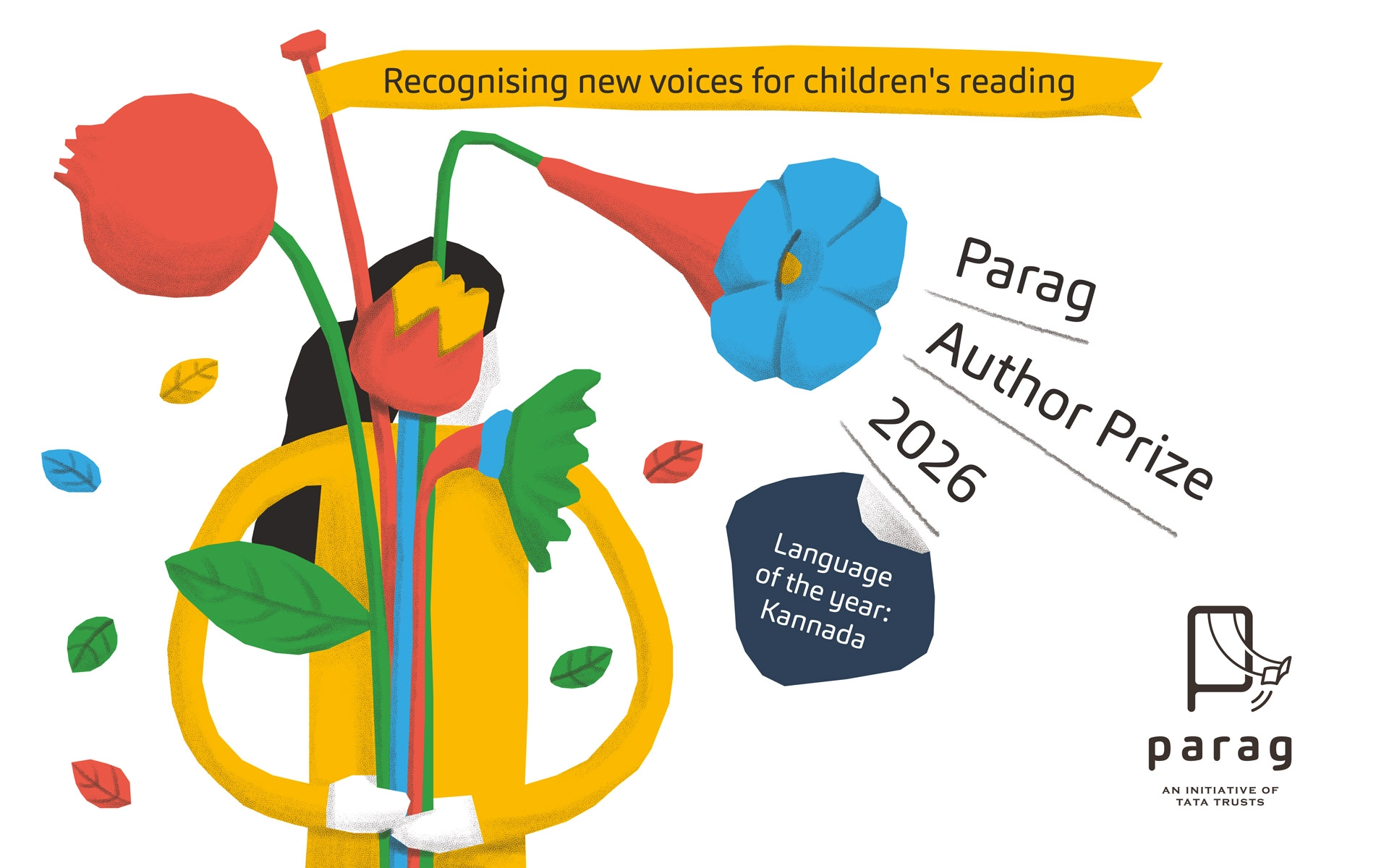
The language for the Parag Author Prize 2026 is Kannada.
The Author Prize is awarded to authors who have started writing for children in the last five years and whose work exhibits a strong literary and contemporary voice.
1. Nomination
The Award opens by inviting nominations from empanelled members. Individuals, organisations, publishers and other stakeholders in the children’s literature sector committed to creating and advocating good-quality children’s literature are invited to nominate.
2. Longlists
Longlists are drawn from the nominated authors in consultation with the jury. The respective longlists comprise of 6 authors. A bibliography is put together for each longlisted author and their books are purchased for jury reading.
3. Shortlists
The jury reads the longlisted works over a few months and independently shortlists 3 or 4 authors.
4. Winners
The winner is selected through a discussion among the jury members; the meeting is anchored by Parag. The author shortlist is discussed in depth along with precise reference to their works, contribution and impact. The winners are announced at the Parag Utsav.
1. Authors who have written a minimum of 2 books qualify for the Parag Author Prize. Writings in magazines may also be considered in addition to published books. Only magazine features are not accepted.
2. Nomination can be based on original writings. It may include original retellings of traditional literature, with words of the author’s own. Translated and adapted works are not referred to by the jury.
3. Self-publications may be accepted for jury reference only in addition to the books produced by publishers.
4. Works written in the last 5 years, from 1st January 2021 to date, are eligible.
5. The author is active, and their works are accessible to children.
6. The author’s work displays an excellence developed through an eagerness to explore and experiment with ideas, genres and the possibilities of their craft.
7. Stories/visual narratives that are culturally appropriate and avoid/challenge stereotypes.
8. The work demonstrates growth and willingness to break known barriers in what defines a children’s author.
9. The author may have written for any age between 0 and 18.
10. The author’s works may include one or more genres—fiction, non-fiction, drama and poetry. Compilations and abridgements are not eligible.
11. The Parag Author Prize is not given posthumously.
1. Is the author prize specific to one language?
Yes, the author category is based on one Indian language. Every year, an Indian language that is different from the previous year is selected.
2. What is the language of Parag Author Prize 2026?
Kannada.
3. Who can nominate?
An empanelled group of various stakeholders of the children’s literature sector in India can nominate. Selected members are invited by Parag to be on the empanelled group. They are librarians, organisations committed to children’s reading, publishers and children’s literature enthusiasts and experts.
4. What is the judging process?
A longlist of authors is drawn from the nominations received along with the jury. Thereafter, books of the longlisted authors are procured and sent to the jury. The jury shortlists authors and, based on the shortlist, the winner is decided by them through a consensus.
5. When are the winners announced?
Winners are announced at the Parag Utsav in November or December.

Brinda Rao has been facilitating resource support and capacity-building programmes for teachers for over two decades. She develops contextual learning materials and supports teachers in engaging with the realities of diverse classrooms.
A major focus of her work is strengthening language learning through children’s literature. She mentors teachers to explore children’s literature beyond prescribed textbooks and to integrate stories, poems and meaningful reading activities into their daily classroom practice. Through the establishment of classroom libraries, she works towards building vibrant reading cultures where children read for enjoyment and to develop critical thinking.
She draws inspiration from the teachers and children she works with and hopes to contribute to them finding joy in reading – just the way she does!
Brinda Rao has been facilitating resource support and capacity-building programmes for teachers for over two decades. She develops contextual learning materials and supports teachers in engaging with the realities of diverse classrooms.
A major focus of her work is strengthening language learning through children’s literature. She mentors teachers to explore children’s literature beyond prescribed textbooks and to integrate stories, poems and meaningful reading activities into their daily classroom practice. Through the establishment of classroom libraries, she works towards building vibrant reading cultures where children read for enjoyment and to develop critical thinking.
She draws inspiration from the teachers and children she works with and hopes to contribute to them finding joy in reading – just the way she does!

Mamta Sagar is a noted Kannada poet, translator and academic from Bengaluru. She has to her credit six collections of poems, four plays, several translations of poetry and prose, an anthology of column writing, a collection of critical essays, five poetry films and INTERVERSIONS, a book of collaborative poetry activities. She has been conferred with the Bhasha Bharathi Translation Award, The World Literary Prize 2024 and Karnataka Sahithya Academy’s Sahithya Shree 2024 Award.
She co-curated a poetry installation at the Piccolo Museo della Poesia, Italy, in 2020. She has facilitated numerous international poetry translation workshops and cross-cultural literary projects. Mamta is the founder-director of Kaavya Sanje, a community poetry initiative, and teaches MA, Contemporary Art Practice at the Srishti Institute of Manipal University, Bengaluru.
Mamta Sagar is a noted Kannada poet, translator and academic from Bengaluru. She has to her credit six collections of poems, four plays, several translations of poetry and prose, an anthology of column writing, a collection of critical essays, five poetry films and INTERVERSIONS, a book of collaborative poetry activities. She has been conferred with the Bhasha Bharathi Translation Award, The World Literary Prize 2024 and Karnataka Sahithya Academy’s Sahithya Shree 2024 Award.
She co-curated a poetry installation at the Piccolo Museo della Poesia, Italy, in 2020. She has facilitated numerous international poetry translation workshops and cross-cultural literary projects. Mamta is the founder-director of Kaavya Sanje, a community poetry initiative, and teaches MA, Contemporary Art Practice at the Srishti Institute of Manipal University, Bengaluru.

Thejaswi Shivanand is an independent scholar of books and Indian publishing history. He is a library educator at Champaca Children’s Library, Bengaluru. He works with schools and library-focussed organisations across the country in the professional development space to support the growth of reader communities. He has an abiding love for picture books and is continually astounded by their ability to reach and embrace readers, irrespective of age and background, with the wholeness of life.
Thejaswi Shivanand is an independent scholar of books and Indian publishing history. He is a library educator at Champaca Children’s Library, Bengaluru. He works with schools and library-focussed organisations across the country in the professional development space to support the growth of reader communities. He has an abiding love for picture books and is continually astounded by their ability to reach and embrace readers, irrespective of age and background, with the wholeness of life.

