
Loading...
Loading...
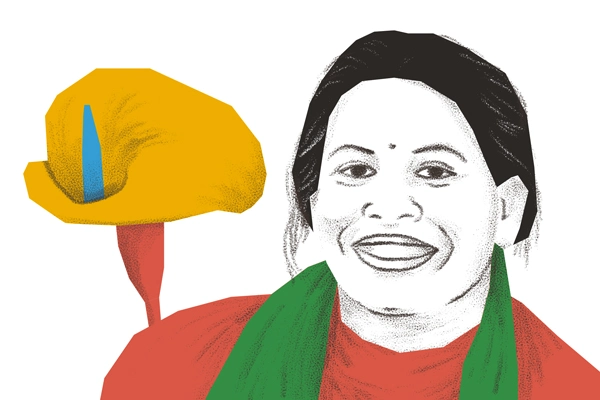
1. You have been illustrating for children for over three decades now. What has changed in children’s illustrations in Indian books since the time you began?
Since the early 90s, I see visible shifts in writing, context, crediting, property and royalty rights, and even in visual images, where digital illustrations have a big role. In context to content, there is a huge transformation in themes and representation, much has moved from folk narration and visuals being static or resembling each other. Illustrations have emerged and evolving on themes of diversity. Over the past two decades, there has been a growing sense of creative freedom among illustrators who now extend their practice beyond merely complementing the written text and create images that hold an independent meaning. There is a conscious effort of breaking away from the western depictions to forming a more Indianised visual language that celebrates our diversity. But at the same time, somewhere, I have a deep fear of excessive use of digital illustration that might lose the simplicity and human warmth that is essential for children’s books.
2. In the 90s, a fraction of books for children in India had to fight against the western imagery and aesthetics. Your work has always stood out with uniqueness and authenticity. How did you manage?
Actually, I hadn’t planned it at all – it happened quite naturally. My childhood was not heavily influenced by Western culture. I studied in a Bangla-medium school in Delhi and mostly grew up with Bangla books and magazines, like Shuktara, Anandamela and Sandesh. Since we were in Delhi, my father was very particular about ensuring that we were not deprived of our language and culture. I wasn’t a very serious reader ever, but whatever I did read in my childhood left a deep impression on me. Those Bangla books sensitised me to my surroundings, my culture, and my country in every sense. So, I feel my roots were never floating or directionless. I’m happy and proud about that, and I think it has helped me to a great extent in maintaining authenticity in my work.
3. What made you consider illustrating for children as a profession?
I studied Applied Arts. Soon after joining an advertising agency, I began to feel quite disconnected and a misfit for the work that I was doing. I found it boring without the act of sketching and drawing. Soon I met a wonderful art director, Deepak Mukherjee, who guided me to the field of illustration and asked me to contact Geeta Dharmarajan, Director of Katha, which I am always grateful for.
At that time, she was running a children’s magazine called Tamasha. Prominent contemporary illustrators like Pulak da, Atanu da, Sigrun Srivastava and Shuddho da were contributing to the magazine. I became a part of the design unit and met some of my college seniors, now also friends – Sujasha and Vandana. It inspired me immensely and pushed me to learn more about this profession.
Eventually, I continued designing Tamasha as well as illustrating for it. Later, Geeta ji connected me to Mala Dayal (Chief Editor of NBT) who gave me an opportunity to work on a book called Hakka Bakka. Before I knew, I had fallen in love with this profession, which continues to give me tremendous satisfaction, respect, joy and fun. Though, not quite enough joy to my bank account.
4. Illustration for children sometimes is considered a ‘less serious’ form of art compared to other art forms. What do you have to say about it?
I find it very important for an illustrator to know the seriousness of this profession. To take a responsibility comes from passion and commitment to be honest. I find many similarities between illustration and other art-based professions like film, painting, music, theatre and dance. All these fields work through rhythm, emotion and expression. Yet, unfortunately, illustration still does not receive the same recognition or value in our society.
5. You are published by many publishers and many kinds of publishers. How have these collaborations been?
As far I have understood, it is only one’s work that helps the illustrator to connect and collaborate, especially in initial stages of the profession. Work always comes first then the illustrator. I’ve always been thriving to work in various mediums and with multiple people, as a result have never said ‘no’ to any opportunity, instead took it as a challenge. Another huge aspect that allowed me to work freely is literally by being a freelancer. Most of the time, I used to be in contact with the editors or the head of the organisation that gave an opportunity to be in closer loops when collaborating.
6. You have illustrated for magazines and for books. Any difference in process and experience?
Illustrating for children’s magazine is great fun. Generally, in publishing, editorials are around short stories, poems, riddles and facts within limited pages. As a result, in consideration of space constraint, there’s a demand of a smaller number of illustrations for each text matter. At times, it allows me to do detailed work. Sometimes I treat magazine as a laboratory, which allows an optimum opportunity to experiment with style, medium, colours and layouts. In the case of books, one has to stay longer with the characters, the environment and the narration. As there’s more freedom to explore different aspects of a long-form story, I try to move beyond the written text and dive deeper.
7. What are some of your special memories in your illustration journey?
A unique and challenging experience was illustrating Winning Team. The challenge for me was to reconceptualise characters like Tenali Raman, Birbal, Gopal Bhar and bring them into contemporary spaces, giving the characters a fresh visual identity while still preserving their original ethos. Another unique experience was while illustrating unseen, quite unknown spaces and imaginative characters for Ek Chuppi Jagah by eminent writer, Vinod Kumar Shukala, published by Jugnoo Prakashan, Ektara.
A moment that has stayed with me is when I spotted one of my books, Hakka Bakka (NBT), in a photograph. While designing an annual report for Care India back in 2001, I was editing one of the photographs, I noticed my book hanging on a thin clothesline among many others in a classroom in post-earthquake in Bhuj. The classroom was terribly damaged, covered in dust, roof-less and yet the students were still trying their best to focus on their studies. Seeing Hakka Bakka hanging in that classroom, reaching those children in such circumstances, made me incredibly happy and deeply satisfied.
8. You had once told us about your childhood having a role to play in you becoming an illustrator. Can you please tell us again?
One of the houses we shifted into was a very interesting British-style constructed quarter in Lodi Road. I remember often changing my routes to school from home, running through different backyard gardens of these houses. Amidst both manicured and wild gardens, I found happiness at simply gazing at these beautiful guava trees, roses and banana plants. My baba would also take us to rivers, mountains and into the wilderness quite often. Those experiences left a deep and lasting impression on me, made me aware of my surroundings and the power of observation.
9. Besides illustration, you are also one of the core faculty members of Riyaaz Academy. Please tell us about your experiences that is related to sector building?
Sushil Shukla (Director of Ektara and a fellow friend) shared the idea of Riyaaz, an academy, a sparse concept, for children’s book illustration with me. His persuasion towards the need and his enthusiasm to start Riyaaz pulled me towards the initiative. He had much more confidence in me than I could have for myself, which inspired me to begin this journey with him and Atanu Da, Sashi Sablok and many others later. In this journey of teaching, I learnt the importance of not only illustration but it’s significance in the current times. Young illustrators have a greater responsibility in deciding what they choose to represent and put out into the world, more now than ever.
10. Which are some of your favourite books and favourite authors and illustrators?
I grew up seeing and reading my all-time favourite – Abol Tabol by Sukumar Ray, Rabindranath Tagore, Shuktara by Narayan Devnath, Rebati Bhushan’s work, and Goopy Gyne Bagha Byne by Upendrakishore Ray Chowdhury, Pather Panchali by Bibhutibhushan Bandyopadhyay, Leo Tolstoy and Ruskin Bond. Along with this, in my professional life, some great illustrators that have deeply inspired me were Maurice Sendak, Eric Carle, Dr. Seuss, Leo Lionni, Jon Klassen, Oliver Jeffers and Ed Young. Additionally, Pulak Bisswas, Atanu Ray, Suddhasattwa Basu, Debabroto Ghosh, Sigrun Srivastava, Bindya Thapar and Manjula Padhmanavam – some of many that inspire me. Also, Rishy Sahani, Rajiv Eipe, Priya Kuriyan to name a few among young illustrators.
11. What message would you have for young illustrators?
Love, enjoy and respect the profession and yourself too as a practising illustrator of children’s books. Keep yourself aware and be observant of your surroundings. Remain curious like a child, no matter how old you might be.
12. What do you feel winning the Parag Significant Contribution Award?
Yes, this award made me feel honoured and extremely happy at a personal level. Along with that, I feel that this award is giving recognition to the entire community of children’s literature that acts as a support. I believe I can say on behalf of illustrators of all ages that it is truly an honour to see our profession being recognised by the Parag initiative of Tata Trusts, a highly prestigious institution in India. I am sure this initiative will draw more attention to this field of work, which holds a vital significance in terms of care, love and investment, especially for the children of our nation.

